
CER Practice: Climate Change — Deposit Return Systems
$4.25
S.E.E.D. Activity | 8th – 12th | Biology, Earth Sciences, Environment
Description
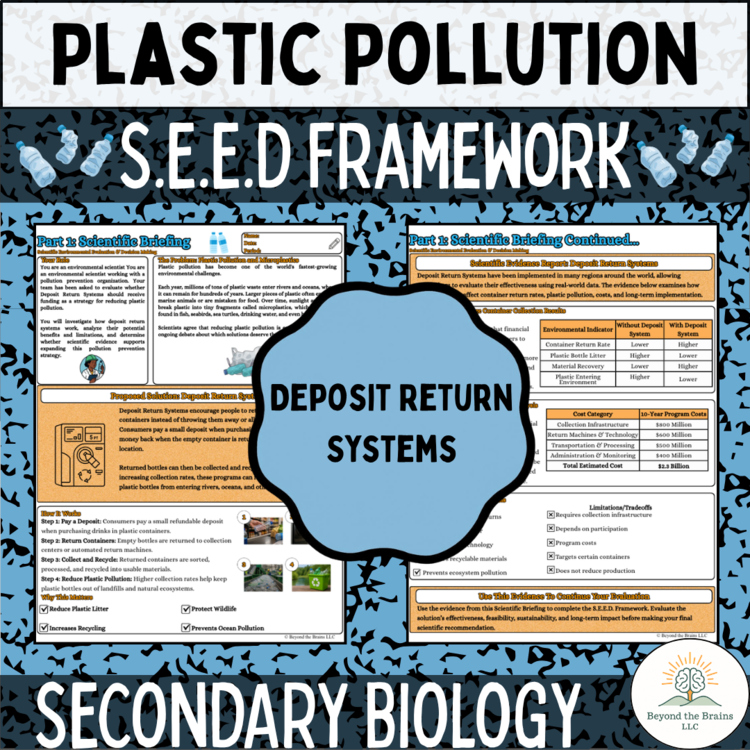
Cleanup technology gets the headlines, but some of the most effective plastic solutions are policy tools. Deposit return systems put a small refundable value on beverage containers, giving people a reason to bring them back instead of tossing them — a pollution prevention strategy designed to increase container collection and reduce the plastic waste entering ecosystems. Does the evidence show it works? Students decide.
What’s inside
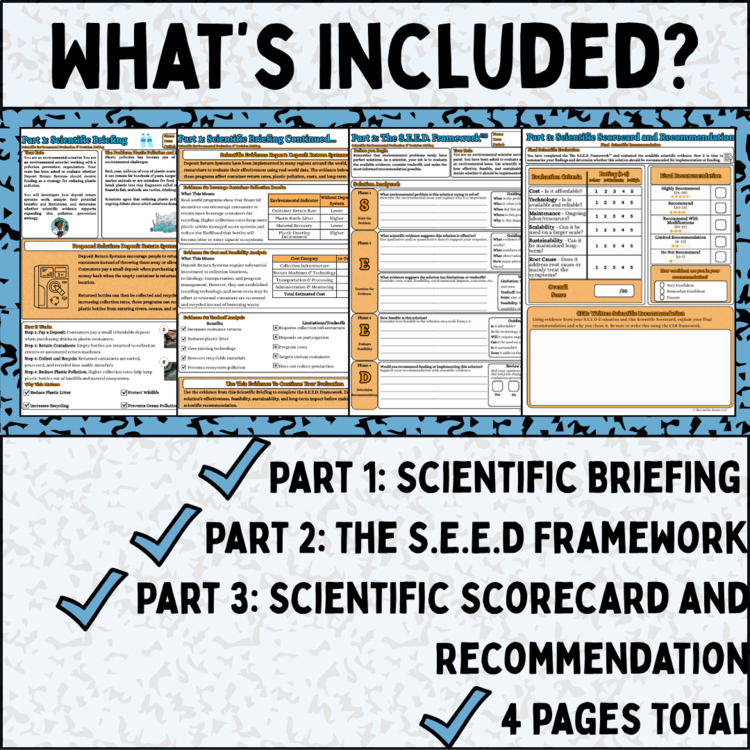
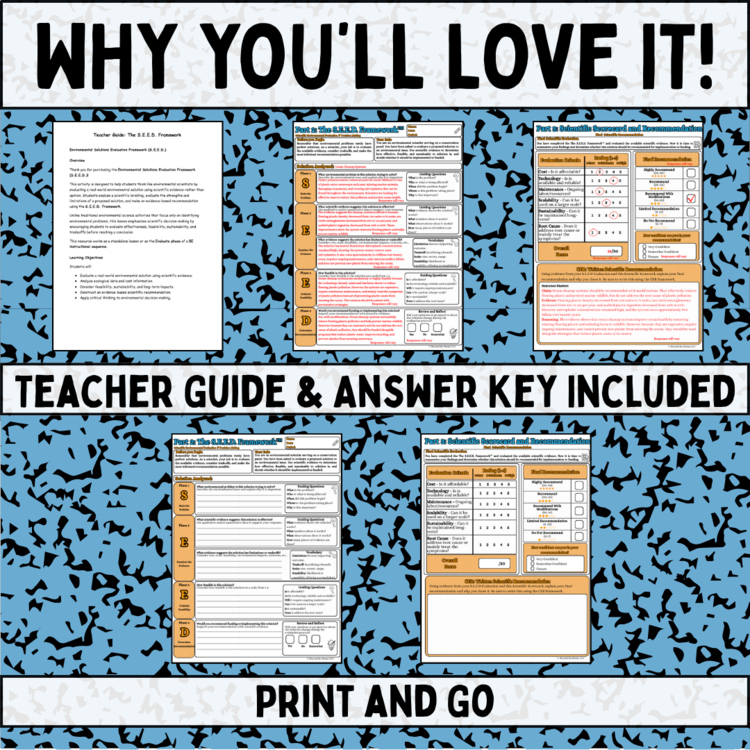
This is a S.E.E.D. Framework activity: students evaluate Deposit Return Systems as a real-world plastic pollution solution using scientific evidence, considering effectiveness, costs, and tradeoffs before writing an evidence-based recommendation. The exact component list (readings, data sets, page count, answer key) is not enumerated in the current listing and should be confirmed before this section is expanded.
How it runs in class
The activity puts students in the evaluator’s seat. They state the problem deposit systems are meant to solve, examine the evidence on collection and waste reduction, evaluate the feasibility of the approach — including its costs and tradeoffs — and determine a recommendation they defend in CER writing. It is an especially useful lesson for showing students that “solutions” in environmental science include policy and behavior design, not just machines, and it sparks strong classroom discussion because students have all handled a bottle deposit or a recycling bin.
Built on the S.E.E.D. Framework
This activity runs the complete S.E.E.D. Framework: State the Problem, Examine the Evidence, Evaluate Feasibility, Determine a Recommendation. The feasibility step does real work here — a policy can be effective in principle and still fail on cost or participation, and students have to reckon with both.
Standards alignment
NGSS: HS-LS2-7, HS-ESS3-4. Grades 8–12 · Biology, Earth Sciences, Environment.
Students have personal data for this one: the bottles and cans their own households return, recycle curbside, or throw away. Starting from their experience makes the policy concrete — a deposit changes what a container is worth at the moment of decision. That behavioral insight is the intellectual core of the activity, and it’s why this lesson often produces the strongest feasibility writing in the plastic line.
Compare it with a technology-based strategy in River Plastic Interceptors, or get all three plastic pollution activities in the Plastic Pollution CER Bundle ($10.25 instead of $12.75 separately). Free resources are in the Free Library.
Reviews
There are no reviews yet.