
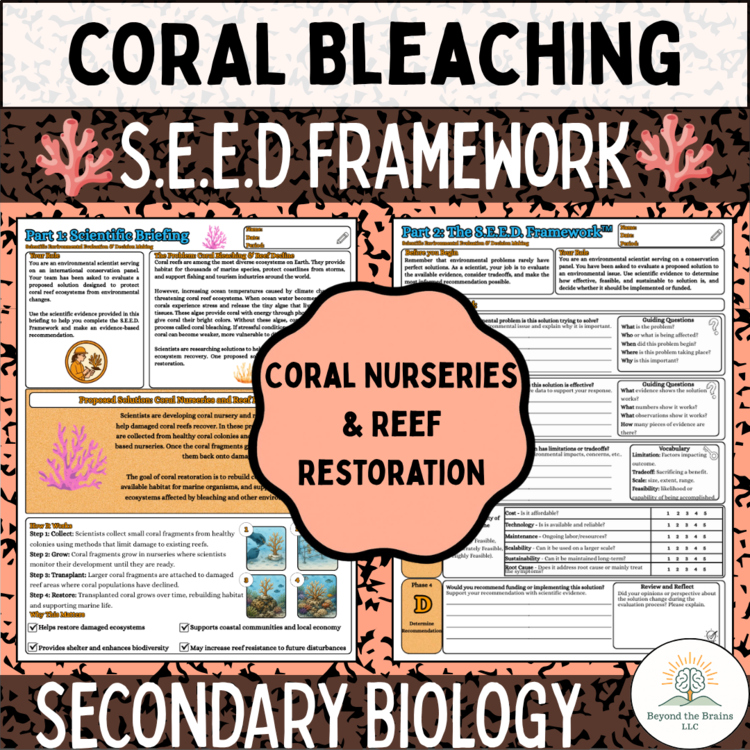

CER Practice: Climate Change Coral Bleaching — Reef Restoration
$4.25
S.E.E.D. Activity | 8th – 12th | Biology, Earth Sciences, Environment
Description
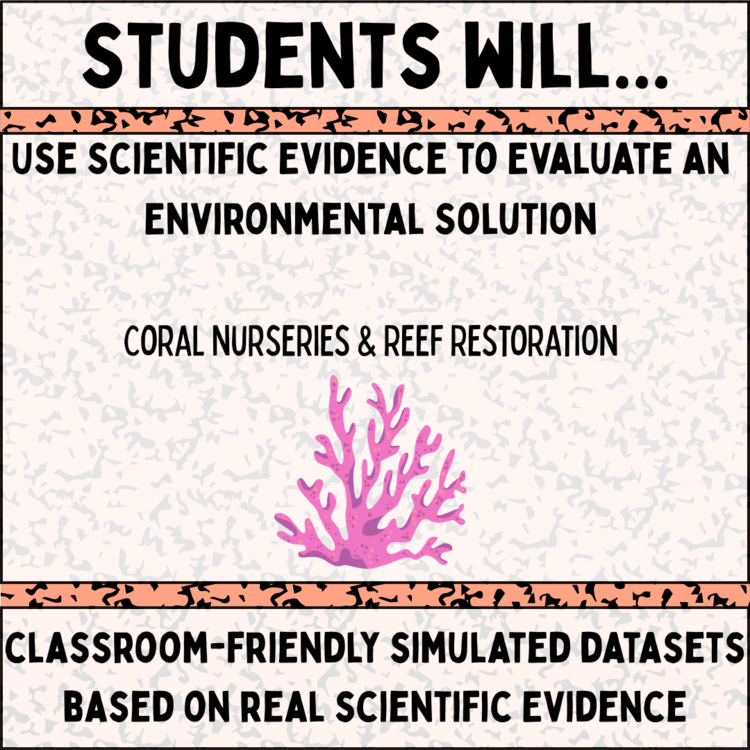
Protecting reefs from bleaching is only half the work — the other half is rebuilding reefs that have already been damaged. Reef restoration is the active discipline: techniques for helping degraded reefs recover, from replanting coral to rebuilding the conditions coral needs. Students evaluate reef restoration techniques as a coral bleaching solution, and they do it the way the field itself has to — by asking what the evidence shows about what actually recovers.
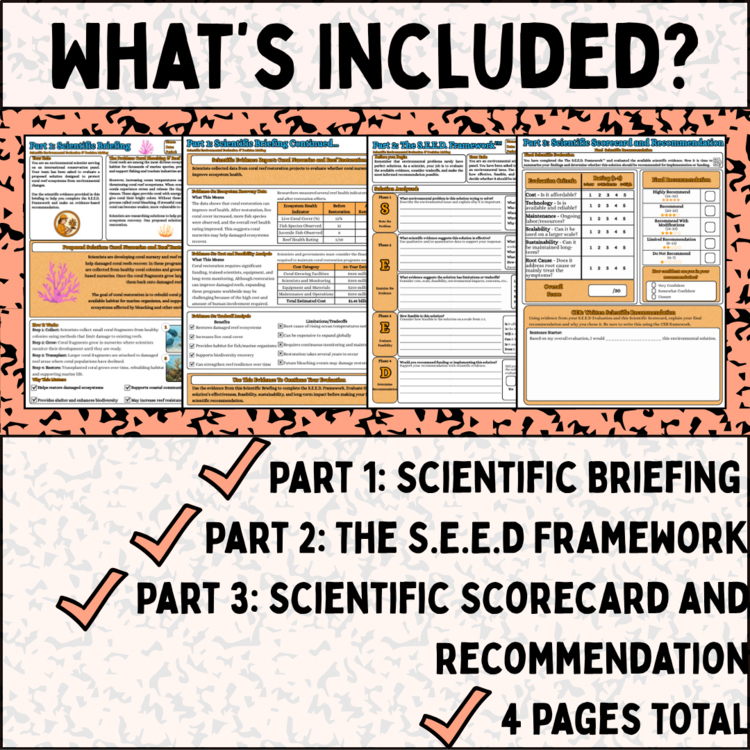
What’s inside
This is a S.E.E.D. Framework activity: students evaluate reef restoration techniques as a coral bleaching solution using scientific evidence, weighing effectiveness, costs, and tradeoffs before writing an evidence-based recommendation. The exact component list (readings, data sets, page count, answer key) is not enumerated in the current listing and should be confirmed before this section is expanded.
How it runs in class
Students state the problem — what bleaching leaves behind and why passive protection may not be enough — examine the evidence on restoration techniques, evaluate feasibility including cost and timescale, and determine a recommendation. Restoration runs on biological time, not news-cycle time, and that tension powers the feasibility discussion: a technique can work and still be too slow, too small, or too expensive to matter at reef scale. Students have to decide how much that counts.
Built on the S.E.E.D. Framework
This activity runs the complete S.E.E.D. Framework: State the Problem, Examine the Evidence, Evaluate Feasibility, Determine a Recommendation. It pairs the framework with the most hands-on strategy in the coral line, so the final CER recommendation reads like a restoration plan defense.
Standards alignment
NGSS: HS-ESS3-4, HS-LS2-6. Grades 8–12 · Biology, Earth Sciences, Environment.
Restoration’s timescale deserves explicit airtime: coral grows in centimeters per year and reefs recover in decades, while bleaching events now arrive faster than that. Students who grasp the mismatch stop asking why restoration alone isn’t the answer — and start asking the better question this activity is really about: which techniques, in which places, buy the most recovery per dollar and per decade?
See restoration in case-study form in the Coral Nurseries case study, or get all three coral strategies in the Coral Bleaching CER Bundle ($10.25 instead of $12.75 separately). Free resources are in the Free Library.
Related products
-
-
-
-
Sale!
CER Practice: Climate Change Plastic Pollution Bundle (Biology)
Original price was: $12.75.$10.25Current price is: $10.25.
Reviews
There are no reviews yet.