


CER Practice: Climate Change Ocean Acidification — Alkalinity
$4.25
S.E.E.D. Activity | 8th – 12th | Biology, Chemistry, Environment
Description
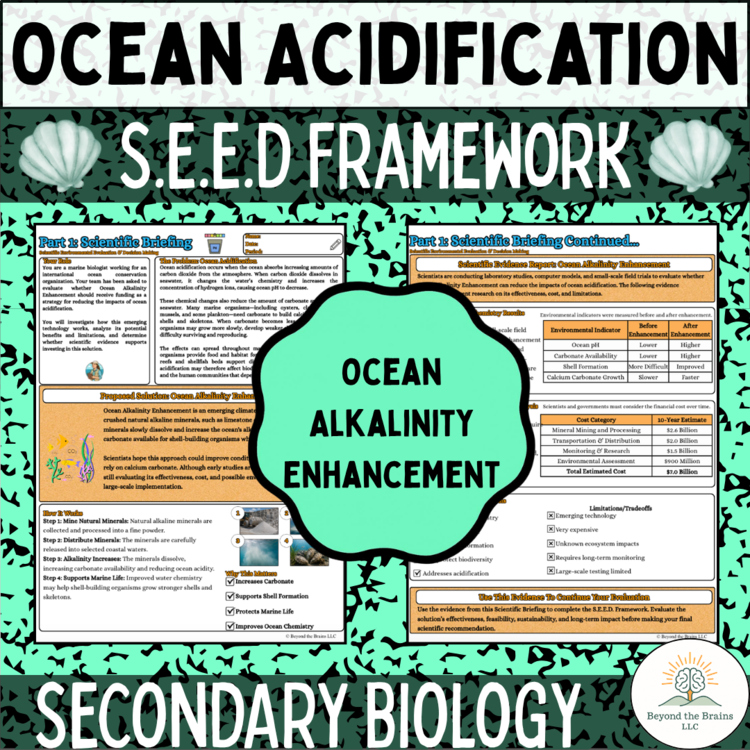
Ocean acidification is, at its core, a chemistry problem: more dissolved CO2, lower pH, less carbonate available for the organisms that build shells and reefs. Ocean alkalinity enhancement attacks the chemistry directly — adding alkaline material to seawater so it can absorb more CO2 and resist acidification. It is one of the most discussed ocean-based climate interventions in the world. Your students’ task is to decide whether the evidence earns it their support.
What’s inside
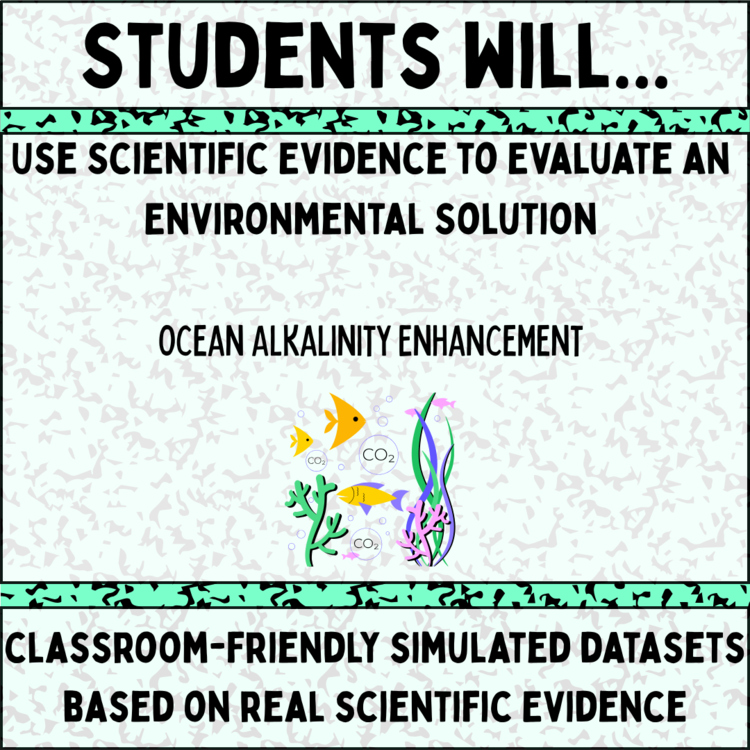
This is a S.E.E.D. Framework activity: students evaluate Ocean Alkalinity Enhancement as a real-world ocean acidification solution using scientific evidence, weighing effectiveness, costs, and tradeoffs before writing an evidence-based recommendation. The exact component list (readings, data sets, page count, answer key) is not enumerated in the current listing and should be confirmed before this section is expanded.
How it runs in class
Students state the problem in chemical terms, examine the evidence for alkalinity enhancement, evaluate feasibility — scale, delivery, and what could go wrong in real ecosystems — and determine a recommendation. Because the mechanism is chemistry students can actually follow, this activity works across biology and chemistry classrooms, and it gives both a rare thing: a climate solution whose logic they can trace from an equation to an ocean.
Built on the S.E.E.D. Framework
This activity runs the complete S.E.E.D. Framework: State the Problem, Examine the Evidence, Evaluate Feasibility, Determine a Recommendation. Alkalinity enhancement is a case where the Evaluate Feasibility step decides the argument — the chemistry is plausible at any scale, but the ocean is very large, and students have to grapple with that honestly.
Standards alignment
NGSS: HS-LS2-7, HS-ESS3-4. Grades 8–12 · Biology, Chemistry, Environment.
This is also the rare climate activity that can anchor a genuine cross-disciplinary moment: the same lesson serves a biology class studying ocean ecosystems and a chemistry class studying acids, buffers, and equilibrium. The intervention’s logic is chemical, its consequences are biological, and students have to hold both registers at once to evaluate it — which is precisely what makes the final recommendation worth reading.
Prefer a biological strategy? Try the Oyster Restoration activity. Or get all three ocean acidification strategies in the Ocean Acidification CER Bundle ($10.25 instead of $12.75 separately). Free resources are in the Free Library.
Reviews
There are no reviews yet.