
CER Practice: Climate Change — River Plastic Interceptors
$4.25
S.E.E.D. Activity | 8th – 12th | Biology, Earth Sciences, Environment
Description
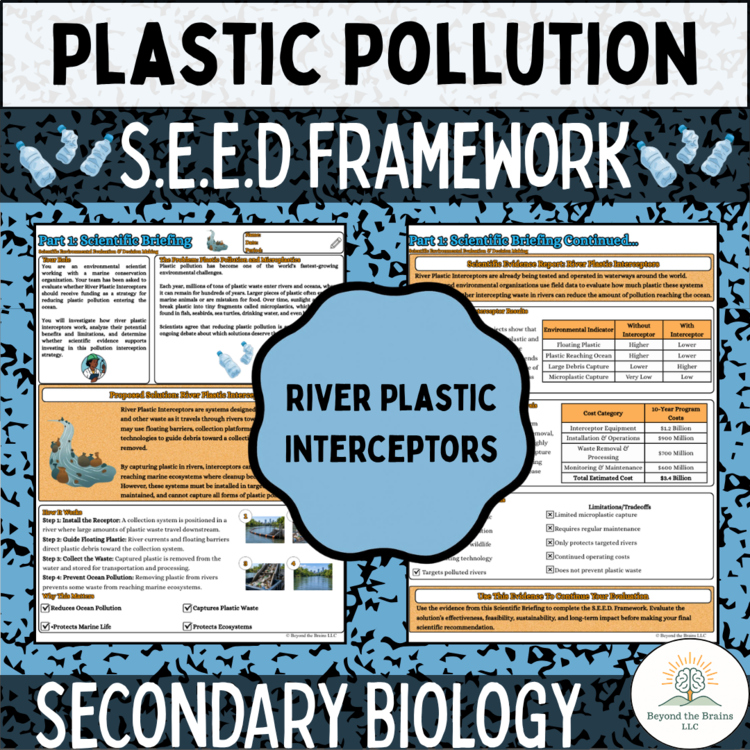
Most ocean plastic doesn’t start in the ocean. It travels there — down rivers that carry floating waste from cities and communities straight out to sea. River plastic interceptors are built to cut that flow off at the chokepoint: systems designed to capture floating plastic in rivers before it reaches the ocean. The idea is elegant. Whether the evidence supports it is your students’ job to decide.
What’s inside
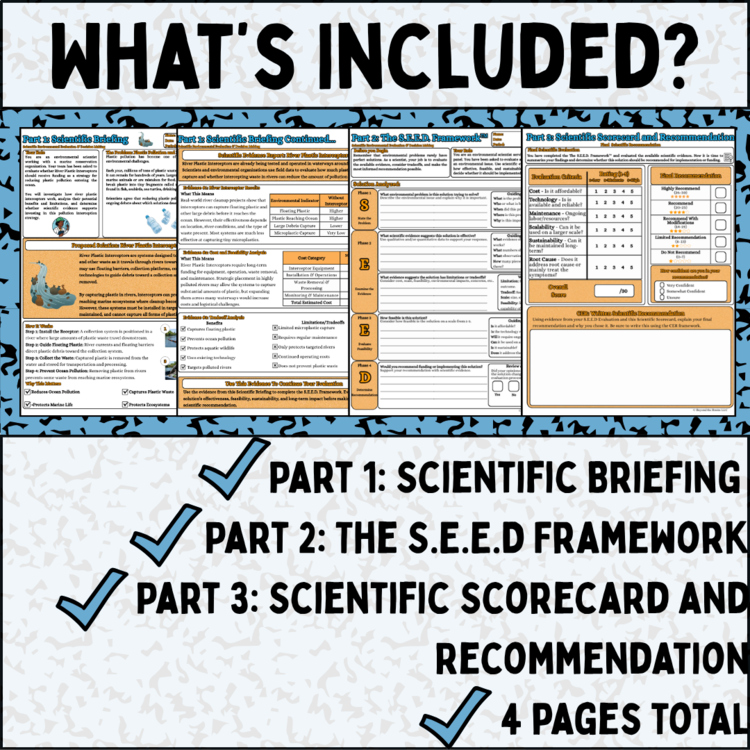
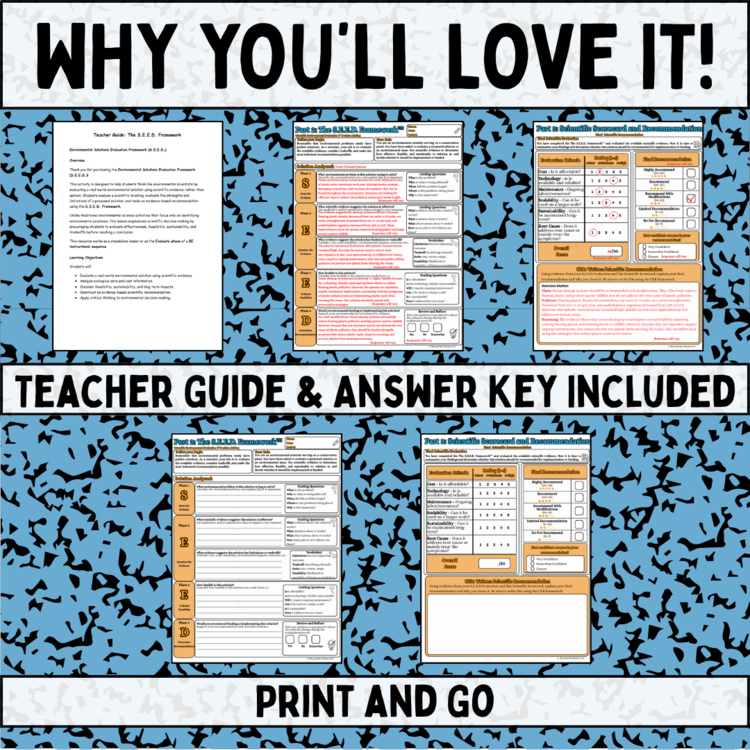
This is a S.E.E.D. Framework activity: students evaluate River Plastic Interceptors as a plastic pollution strategy using scientific evidence, weighing the strategy’s effectiveness, costs, and tradeoffs before writing an evidence-based recommendation. The exact component list (readings, data sets, page count, answer key) is not enumerated in the current listing and should be confirmed before this section is expanded.
How it runs in class
Students work through the problem the way an environmental scientist would. They start by framing the problem — how plastic moves through river systems — then examine the evidence for interceptor systems, evaluate whether the approach is feasible at real-world scale, and finish by determining a recommendation they must defend with the evidence they gathered. The activity fits a single solution-focused lesson inside a plastic pollution or human impact unit, and it pairs naturally with a class debate on where cleanup money is best spent.
Built on the S.E.E.D. Framework
This activity runs the complete S.E.E.D. Framework: State the Problem, Examine the Evidence, Evaluate Feasibility, Determine a Recommendation. The final CER writing is the recommendation — a claim about whether interceptors deserve support, backed by the evidence from the activity.
Standards alignment
NGSS: HS-LS2-7, HS-ESS3-4. Grades 8–12 · Biology, Earth Sciences, Environment.
Bring it home before you close: every class sits in a watershed. Asking students to trace where their local waterway runs — and what it would carry to the sea — converts an abstract global flow into their own geography. Interceptors stop being a faraway technology and become a question about their river, which is when the feasibility arguments in their CER writing get noticeably sharper.
Evaluating the full set of plastic solutions? This activity is one of three in the Plastic Pollution CER Bundle — $10.25 for all three instead of $12.75 separately. Free resources are in the Free Library.

Reviews
There are no reviews yet.