


CER Practice: Climate Change Ocean Acidification — Seagrass Restore
$4.25
S.E.E.D. Activity | 8th – 12th | Biology, Earth Sciences, Environment
Description
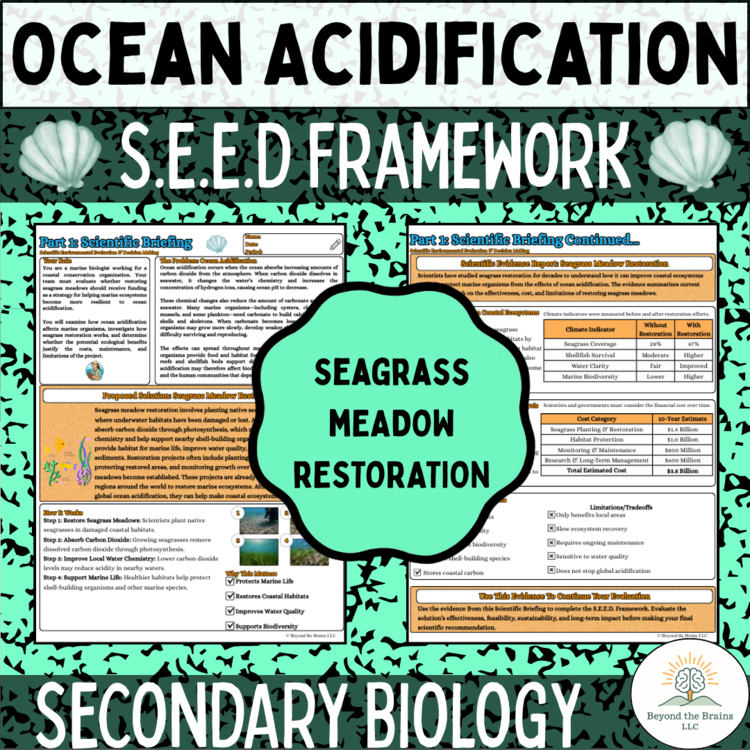
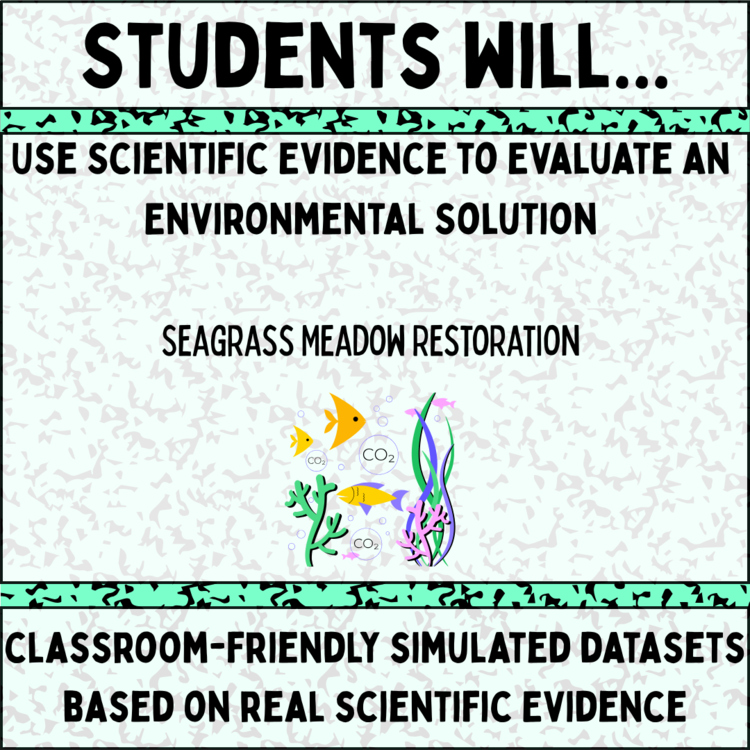
The least glamorous ecosystem in the ocean may be one of the most useful. Seagrass meadows photosynthesize in shallow coastal water, drawing carbon out of the local water column and creating pockets of less acidic, organism-friendly ocean — while also storing carbon in their sediments for the long term. Restoring seagrass is a nature-based answer to ocean acidification. Students evaluate whether the evidence supports investing in it.
What’s inside
This is a S.E.E.D. Framework activity: students evaluate seagrass restoration as a real-world ocean acidification solution using scientific evidence, weighing effectiveness, costs, and tradeoffs before writing an evidence-based recommendation. The exact component list (readings, data sets, page count, answer key) is not enumerated in the current listing and should be confirmed before this section is expanded.
How it runs in class
Students state the problem acidification poses for coastal ecosystems, examine the evidence on seagrass meadows and local water chemistry, evaluate feasibility — where restoration can work, how long it takes, what threatens it — and determine a recommendation. The activity gives students a solution rooted in ecosystem processes rather than technology, which makes it the right counterweight after chemistry- or breeding-based strategies, and a clean way to bring blue carbon into context.
Built on the S.E.E.D. Framework
This activity runs the complete S.E.E.D. Framework: State the Problem, Examine the Evidence, Evaluate Feasibility, Determine a Recommendation. Seagrass makes the Examine the Evidence step genuinely ecological — the mechanism runs through a living system, and students have to evaluate the whole system, not a single variable.
Standards alignment
NGSS: HS-LS2-7, HS-ESS3-4. Grades 8–12 · Biology, Earth Sciences, Environment.
Seagrass also reframes what counts as climate infrastructure. Students are used to solutions being built; this one is grown, and it protects coastlines and shelters juvenile fish while it buffers chemistry. Asking students to value those stacked benefits — and to weigh how long a meadow takes to establish against how quickly it can be damaged — gives their feasibility analysis a richness the engineered solutions don’t demand.
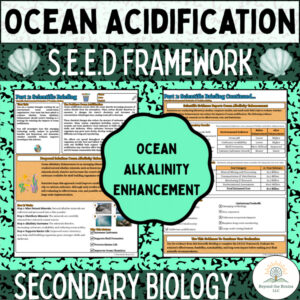
Contrast it with a chemical approach in the Alkalinity Enhancement activity, or get all three strategies in the Ocean Acidification CER Bundle ($10.25 instead of $12.75 separately). Free resources are in the Free Library.
Related products
-
-
Sale!
CER Practice: Climate Change Deforestation Bundle (Biology)
Original price was: $12.75.$10.25Current price is: $10.25. -
-
Reviews
There are no reviews yet.