

CER Practice: Climate Change Ocean Acidification Bundle (Biology)
Original price was: $12.75.$10.25Current price is: $10.25.
S.E.E.D. Bundle | 8th – 12th | Biology, Chemistry, Environment
Description
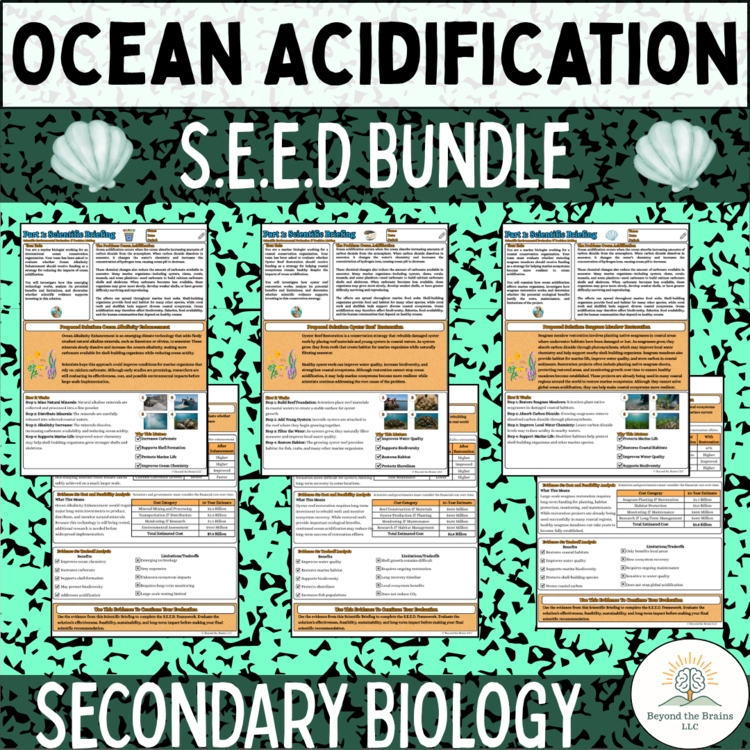
Once students understand ocean acidification, the next question is the one this bundle is built on: what can actually be done about it? Students move beyond learning about ocean acidification into the role of environmental scientists, evaluating three real mitigation strategies that work through entirely different mechanisms.
One changes the chemistry of the water itself. One breeds the organisms to withstand it. One restores the ecosystems that buffer it. Judging all three against evidence — not enthusiasm — is the work of the bundle.
What’s inside
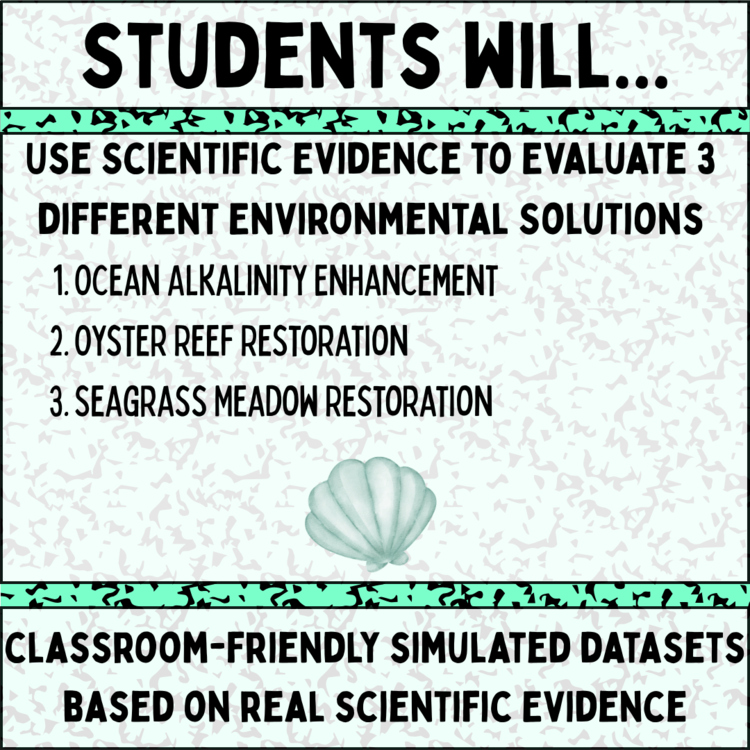
- Ocean Alkalinity Enhancement — students evaluate adding alkalinity to seawater as a direct response to acidification.
- Resilient Oysters — students evaluate selective breeding of oysters that can withstand more acidic conditions.
- Seagrass Restoration — students evaluate restoring seagrass meadows as a living buffer against acidification.
The three activities total $12.75 purchased separately; the bundle is $10.25.
How it runs in class
Each activity follows the same evaluation sequence, so students improve at the process as they repeat it — and the third activity invites the comparison the bundle is designed for: chemistry vs. biology vs. ecosystem restoration. The set works as the second half of an ocean acidification arc after students have analyzed the data behind the problem, and it closes well with students defending which strategy they would fund first.
Built on the S.E.E.D. Framework
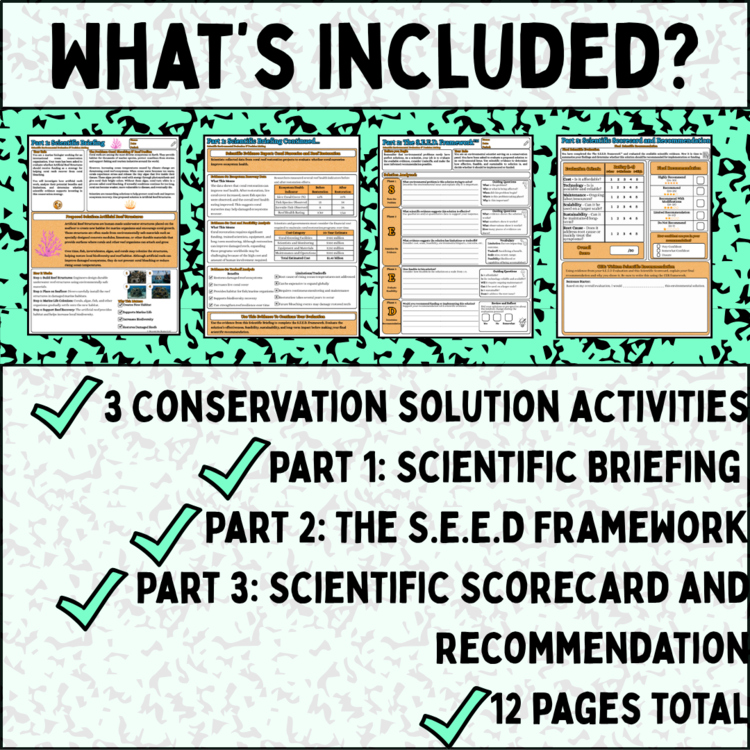
All three activities run the complete S.E.E.D. Framework: State the Problem, Examine the Evidence, Evaluate Feasibility, Determine a Recommendation — ending in evidence-based CER recommendation writing.
Standards alignment
NGSS: HS-LS2-6, HS-LS2-7, HS-ESS3-4. Grades 8–12 · Biology, Chemistry, Environment.
Close the bundle the way a funding panel would: each student (or team) must allocate a fixed ocean-conservation budget across the three strategies and defend the allocation from the evidence in their three recommendations. The exercise exposes a real scientific truth — chemistry, breeding, and ecosystem restoration are not competitors so much as complements — while still forcing the prioritization that makes evaluation honest.
Start with the problem itself in the Ocean Acidification Data Analysis Worksheet, or take a single strategy first with the Alkalinity Enhancement activity on its own. Free resources are in the Free Library.
Related products
-
-
Sale!
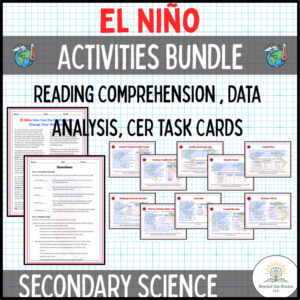
El Niño Activities Bundle: Reading Comprehension, Data Analysis & CER Task Cards
Original price was: $9.24.$6.75Current price is: $6.75. -
-
Reviews
There are no reviews yet.