
CER Practice: Climate Change Coral Bleaching — Artificial Reefs
$4.25
S.E.E.D. Activity | 8th – 12th | Biology, Earth Sciences, Environment
Description
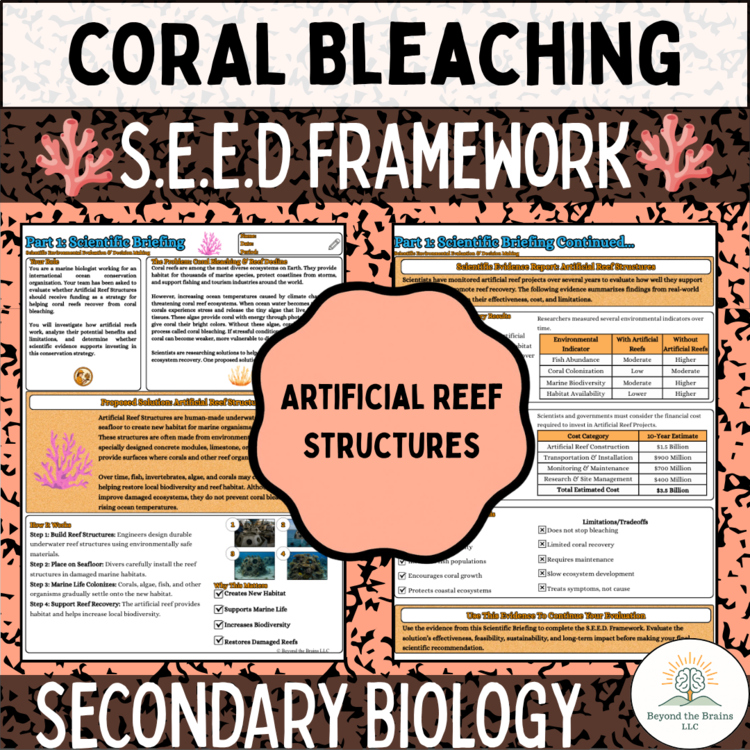
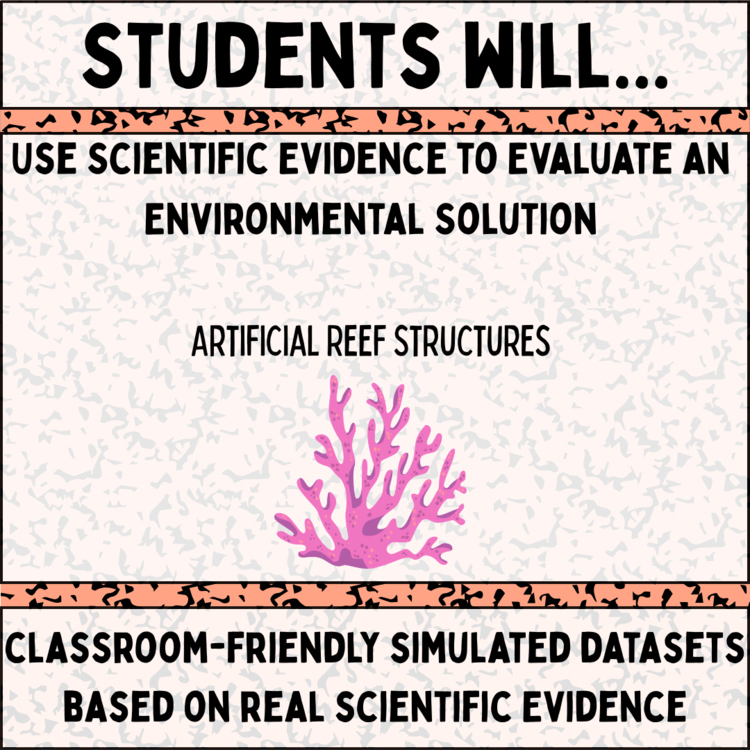
When a reef bleaches and breaks down, the coral loses more than color — it loses structure, and with it the habitat that thousands of species depend on. Artificial reefs answer with construction: deliberately placed structures that give marine life substrate and shelter while natural reef recovers, or where it no longer can. Students evaluate whether building reefs is a sound response to coral bleaching — on the evidence, not the renderings.
What’s inside
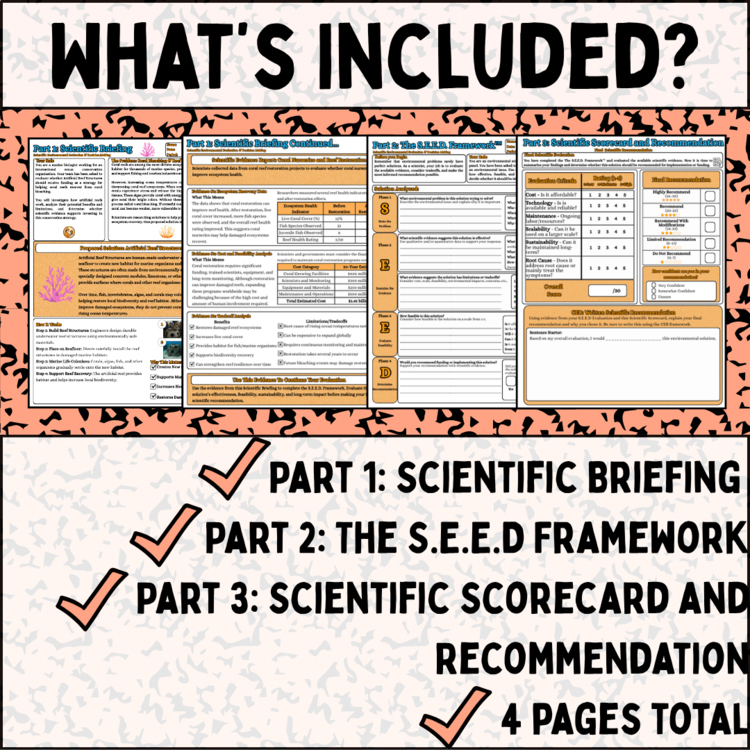
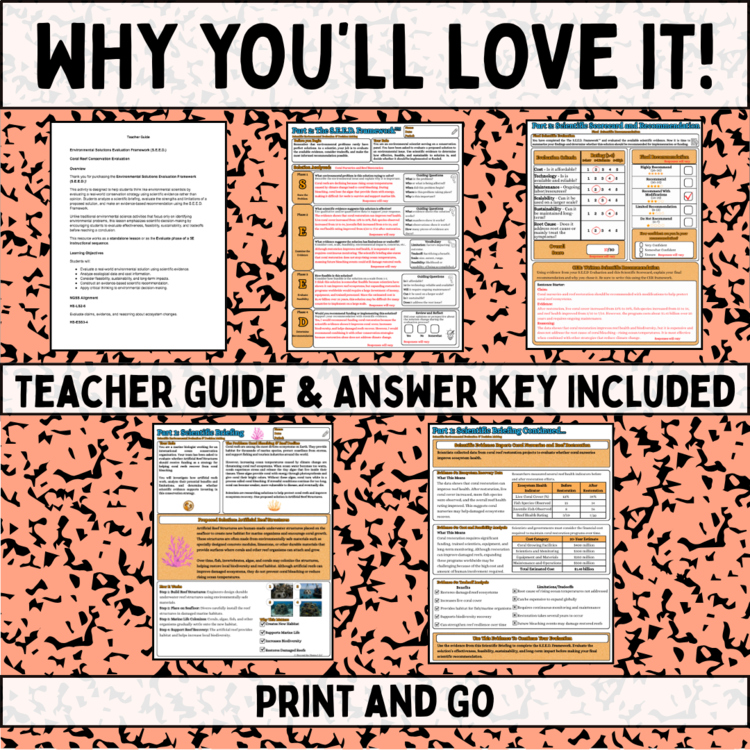
This is a S.E.E.D. Framework activity: students evaluate Artificial Reefs as a coral bleaching solution using scientific evidence, weighing effectiveness, costs, and tradeoffs before writing an evidence-based recommendation. The exact component list (readings, data sets, page count, answer key) is not enumerated in the current listing and should be confirmed before this section is expanded.
How it runs in class
Students state the problem — what bleaching destroys and what a reef community needs — examine the evidence for artificial reef structures, evaluate feasibility including cost, placement, and materials, and determine a recommendation. The activity is a good entry point into the coral line because the strategy is tangible: students can picture the intervention, which makes the evaluative questions — does structure alone rebuild an ecosystem? — sharper rather than easier.
Built on the S.E.E.D. Framework
This activity runs the complete S.E.E.D. Framework: State the Problem, Examine the Evidence, Evaluate Feasibility, Determine a Recommendation. The CER writing at the end is the recommendation: build, or don’t — and here’s the evidence.
Standards alignment
NGSS: HS-LS2-7, HS-ESS3-4. Grades 8–12 · Biology, Earth Sciences, Environment.
The sharpest question in this activity is what a reef actually is. If a structure hosts fish and coral colonizes it, has the ecosystem been restored — or a convincing habitat substitute built? Students land on both sides, and the evidence has to sort out which functions an artificial reef demonstrably replaces and which it doesn’t. That function-by-function thinking is exactly how restoration ecologists talk, and students rise to it.
Go further with active restoration techniques in the Reef Restoration activity, or get all three coral strategies in the Coral Bleaching CER Bundle ($10.25 instead of $12.75 separately). Free resources are in the Free Library.
Related products
-
Sale!
Climate Change: Coral Reef Restoration Case Study Bundle Activity (HS Biology)
Original price was: $7.50.$6.50Current price is: $6.50. -
Sale!
CER Practice: Climate Change Ocean Acidification Bundle (Biology)
Original price was: $12.75.$10.25Current price is: $10.25. -
-
Sale!
CER Practice: Climate Change Arctic Sea Ice Bundle (Biology)
Original price was: $12.75.$10.25Current price is: $10.25.
Reviews
There are no reviews yet.