


CER Practice: Climate Change Ocean Acidification — Oysters
$4.25
S.E.E.D. Activity | 8th – 12th | Biology, Earth Sciences, Environment
Description
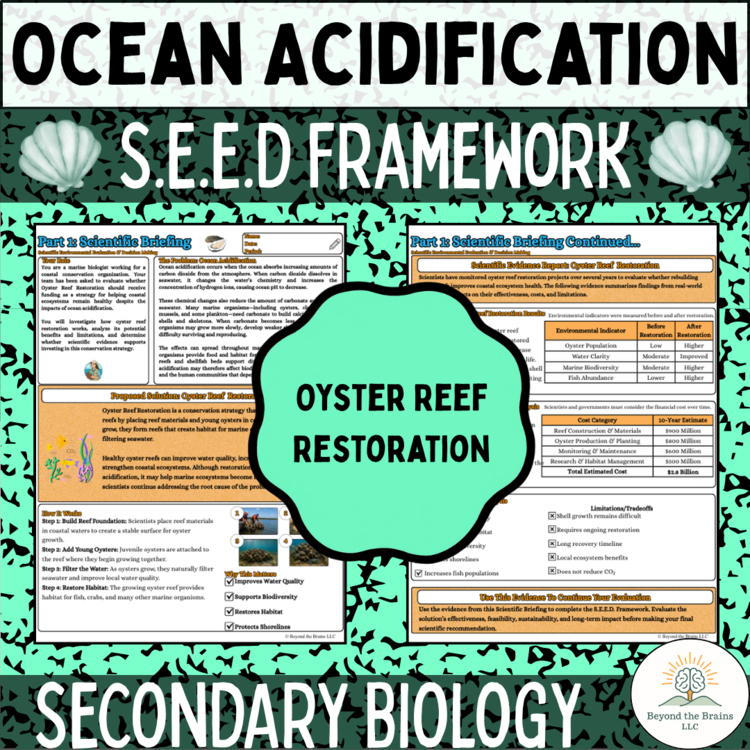
Oysters build their shells from the carbonate that acidifying oceans are taking away — which makes them both a victim of ocean acidification and, potentially, part of the answer. Scientists are selectively breeding oysters for resilience, producing lines that can grow and build reefs in more acidic water. Students evaluate that strategy: breeding a tougher oyster as a real-world response to a changing ocean.
What’s inside
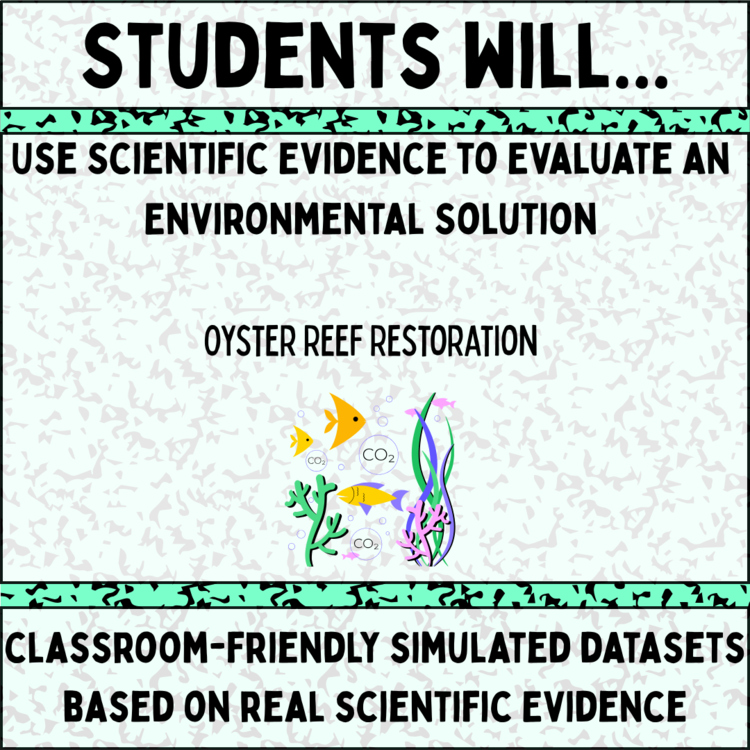
This is a S.E.E.D. Framework activity: students evaluate selective breeding of resilient oysters as a real-world ocean acidification solution using scientific evidence, weighing effectiveness, costs, and tradeoffs before writing an evidence-based recommendation. The exact component list (readings, data sets, page count, answer key) is not enumerated in the current listing and should be confirmed before this section is expanded.
How it runs in class
Students state the problem — what acidification does to shell-building organisms and the reefs and fisheries that depend on them — then examine the evidence on selective breeding, evaluate feasibility (breeding timelines, scale, ecosystem fit), and determine a recommendation in CER writing. The activity connects genetics and heredity content to a live environmental problem, which makes it a natural fit mid-unit in either topic, and students tend to have strong instincts about “engineering” organisms that the evidence then has to discipline.
Built on the S.E.E.D. Framework
This activity runs the complete S.E.E.D. Framework: State the Problem, Examine the Evidence, Evaluate Feasibility, Determine a Recommendation. It shows students the framework handling a biological solution — where feasibility includes living timelines and ecological side effects, not just engineering specs.
Standards alignment
NGSS: HS-LS2-7, HS-ESS3-4. Grades 8–12 · Biology, Earth Sciences, Environment.
The activity doubles as applied genetics: selective breeding is heredity with a deadline. Students who have studied traits and inheritance meet those concepts here wearing waders — broodstock selection, generational timelines, and the trade-off between a resilient oyster and a genetically diverse one. That last tension, resilience versus diversity, is a sophisticated scientific question, and students are fully capable of arguing it from evidence.
Pair it with an ecosystem-scale strategy in the Seagrass Restoration activity, or get all three strategies in the Ocean Acidification CER Bundle ($10.25 instead of $12.75 separately). Free resources are in the Free Library.
Related products
-
Sale!
CER Practice: Climate Change Arctic Sea Ice Bundle (Biology)
Original price was: $12.75.$10.25Current price is: $10.25. -
-
Sale!
CER Practice: Climate Change Ocean Acidification Bundle (Biology)
Original price was: $12.75.$10.25Current price is: $10.25. -
Reviews
There are no reviews yet.