

CER Practice: Climate Change Coral Bleaching — Coral Evolution
$4.25
S.E.E.D. Activity | 8th – 12th | Biology, Earth Sciences, Environment
Description
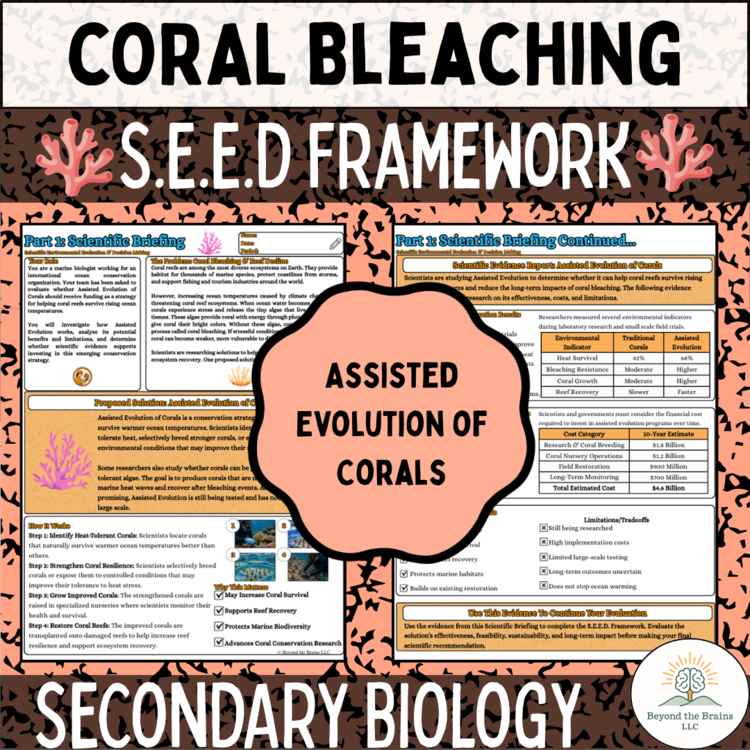
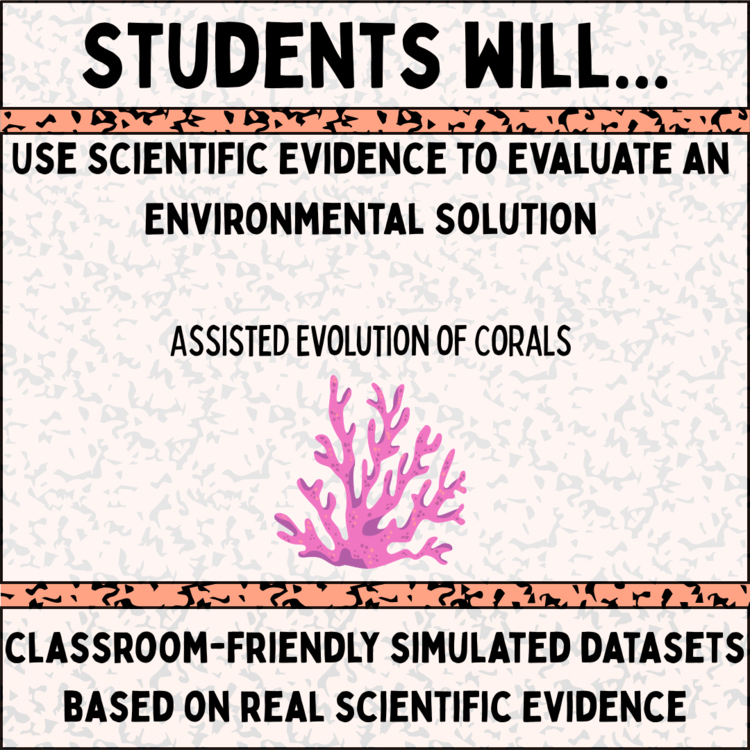
Corals are adapting to warming oceans — just not fast enough. Assisted evolution tries to close that gap: scientists selectively breed and condition corals for heat resistance, producing strains that can survive temperatures that would bleach their parents. It is evolution with a deadline and a helping hand. Students evaluate whether assisting coral evolution is a sound response to bleaching, using the scientific evidence.
What’s inside
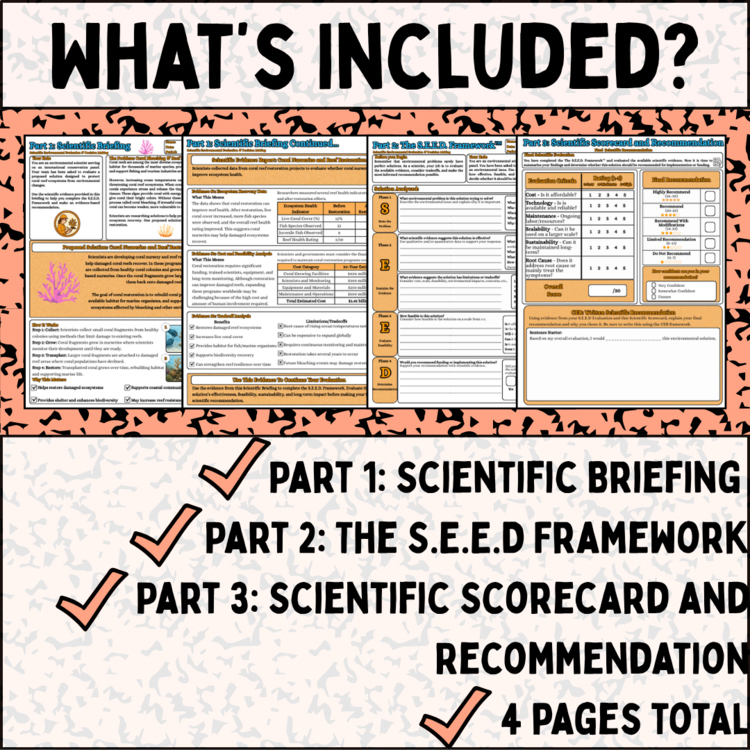
This is a S.E.E.D. Framework activity: students evaluate assisted evolution of heat-resistant corals as a coral bleaching solution using scientific evidence, weighing effectiveness, costs, and tradeoffs before writing an evidence-based recommendation. The exact component list (readings, data sets, page count, answer key) is not enumerated in the current listing and should be confirmed before this section is expanded.
How it runs in class
Students state the problem — bleaching driven by thermal stress on coral-algal symbiosis — then examine the evidence on assisted evolution, evaluate feasibility (breeding timelines, scale, genetic and ecological questions), and determine a recommendation. The activity lands squarely in evolution and heredity territory as well as climate content, and it reliably surfaces the deepest question in the coral line: when humans accelerate a species’ evolution to save it, what exactly are we conserving? Students’ CER writing has to carry that weight with evidence.
Built on the S.E.E.D. Framework
This activity runs the complete S.E.E.D. Framework: State the Problem, Examine the Evidence, Evaluate Feasibility, Determine a Recommendation. Feasibility here includes time itself — whether assisted evolution can move at the speed of warming is a scientific question students can genuinely argue.
Standards alignment
NGSS: HS-LS2-7, HS-ESS3-4. Grades 8–12 · Biology, Earth Sciences, Environment.
Expect the ethics conversation, and let it run: assisting a species’ evolution is intervention at the deepest level biology offers. Students should have to separate the scientific question (does it work?) from the values question (should we?) — and then notice how their recommendation changes when feasibility evidence is strong versus speculative. S.E.E.D. keeps both questions in the room without letting either one impersonate the other.
Compare a structural strategy in the Artificial Reefs activity, or get all three coral strategies in the Coral Bleaching CER Bundle ($10.25 instead of $12.75 separately). Free resources are in the Free Library.
Reviews
There are no reviews yet.