

CER Practice: Climate Change Arctic Sea Ice Thickening
$4.25
S.E.E.D. Activity | 8th – 12th | Biology, Earth Sciences, Environment
Description
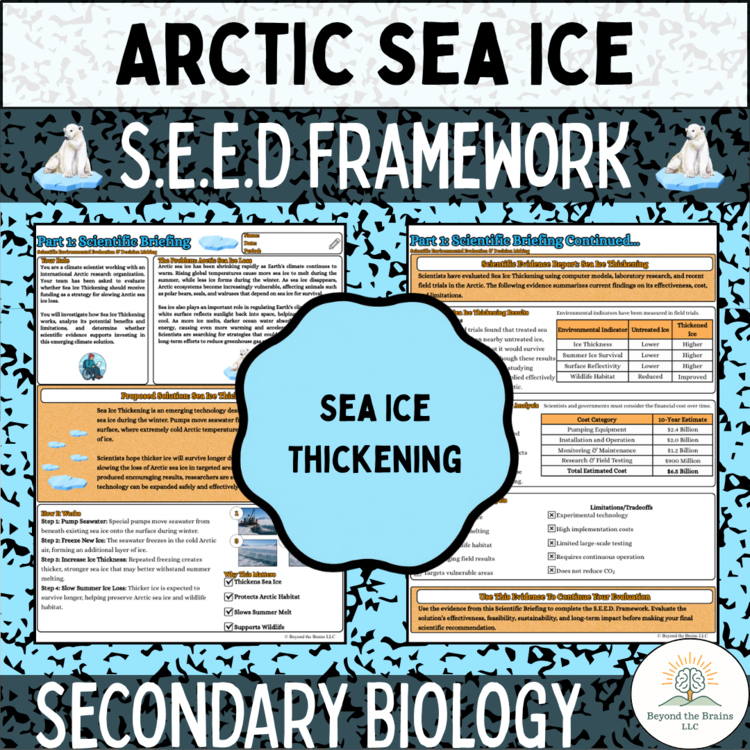
If the Arctic is losing ice, could we simply make more of it? Sea ice thickening is a proposed geoengineering strategy built on a direct idea: pump seawater onto the surface of existing ice in winter, where the cold air freezes it and builds the ice thicker before summer melt arrives. It is one of the boldest climate intervention proposals under discussion — and exactly the kind of claim students should learn to evaluate rather than admire.
What’s inside
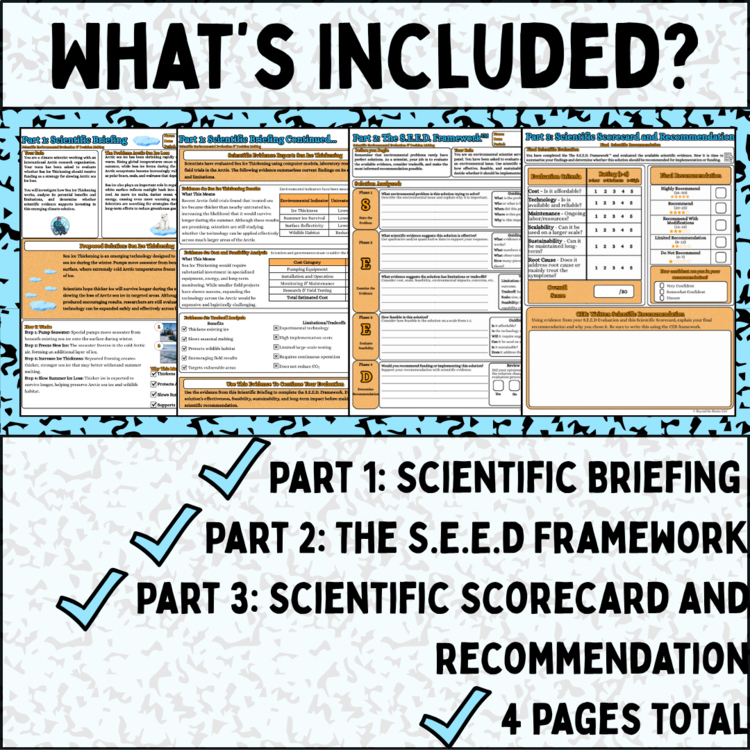
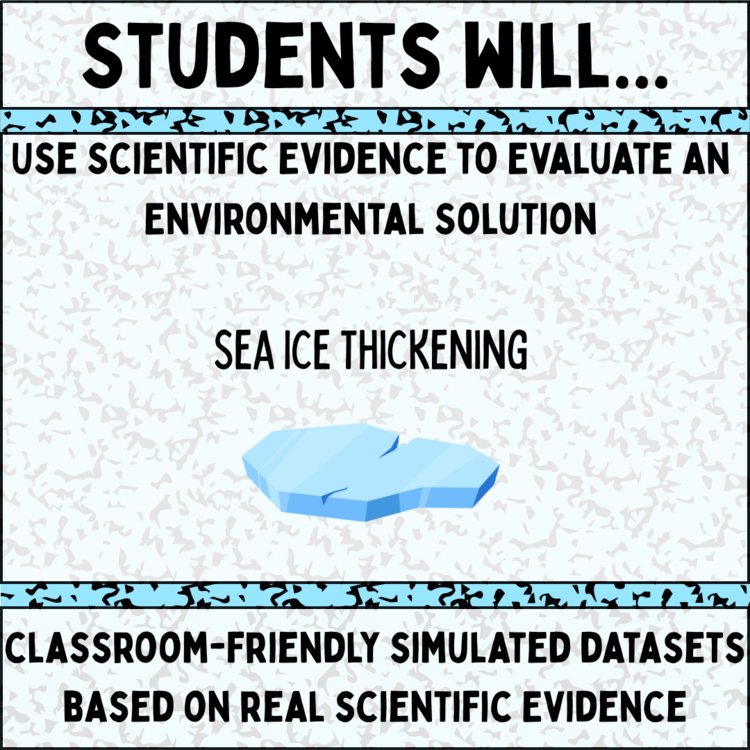
This is a S.E.E.D. Framework activity: students evaluate Arctic Sea Ice Thickening as a proposed climate solution using scientific evidence, weighing effectiveness, costs, and tradeoffs before writing an evidence-based recommendation. The exact component list (readings, data sets, page count, answer key) is not enumerated in the current listing and should be confirmed before this section is expanded.
How it runs in class
Students state the problem — accelerating sea ice loss and what rides on it — then examine the evidence for the thickening proposal, evaluate feasibility at Arctic scale, and determine a recommendation. Geoengineering proposals are a gift for practicing evaluation, because the physics can be sound while the scale, cost, and side effects are all contestable. Students have to hold all of that at once, which is precisely the thinking the activity is designed to produce.
Built on the S.E.E.D. Framework
This activity runs the complete S.E.E.D. Framework: State the Problem, Examine the Evidence, Evaluate Feasibility, Determine a Recommendation. The Evaluate Feasibility step is where this activity lives — a recommendation for or against a geoengineering proposal is only as good as the feasibility analysis behind it.
Standards alignment
NGSS: HS-LS2-7, HS-ESS3-4. Grades 8–12 · Biology, Earth Sciences, Environment.
The feasibility conversation naturally turns quantitative: how much ice, over how large an area, maintained for how long, at what energy cost? Even rough orders of magnitude change the discussion from ‘could work’ to ‘here is what working would require.’ That instinct — putting scale numbers on a proposal before endorsing it — is one of the most durable habits this activity builds.
Contrast it with an emissions-first approach in the Black Carbon Reduction activity, or get all three Arctic strategies in the Arctic Sea Ice CER Bundle ($10.25 instead of $12.75 separately). Free resources are in the Free Library.
Reviews
There are no reviews yet.