
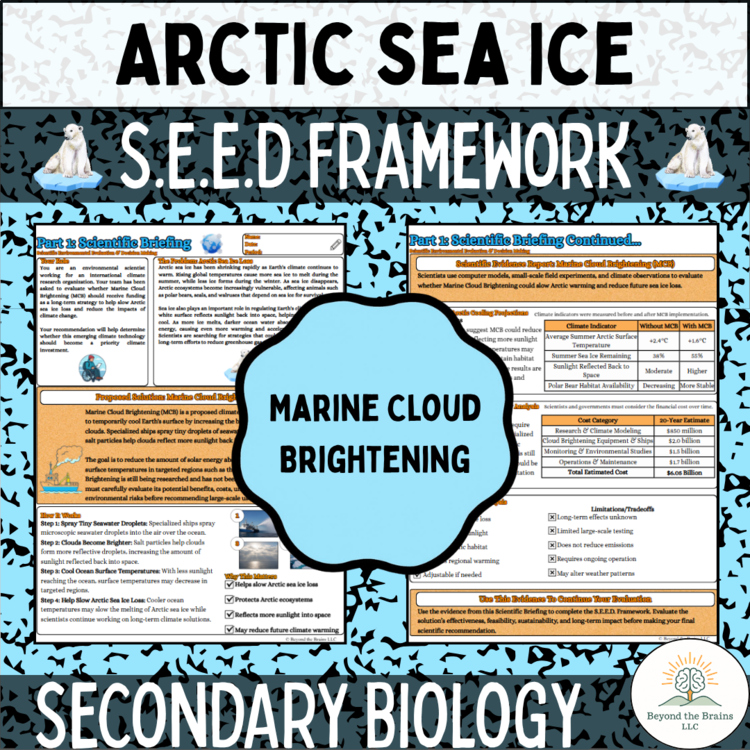

CER Practice: Climate Change Arctic Sea Ice — Marine Cloud
$4.25
S.E.E.D. Activity | 8th – 12th | Biology, Earth Sciences, Environment
Description
Clouds are the planet’s adjustable sunshade — brighter clouds reflect more sunlight back to space. Marine cloud brightening proposes to use that physics for the Arctic: spraying fine sea-salt particles into low marine clouds to make them more reflective, cooling the water and ice below. It is among the most debated climate intervention ideas in the world, which makes it ideal material for students learning to evaluate a proposal rather than just learn about one.
What’s inside
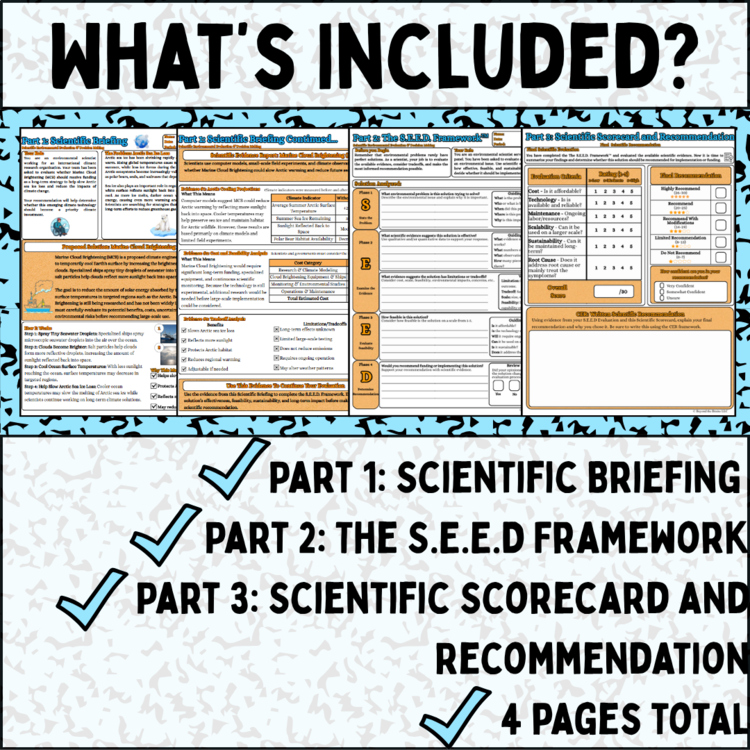
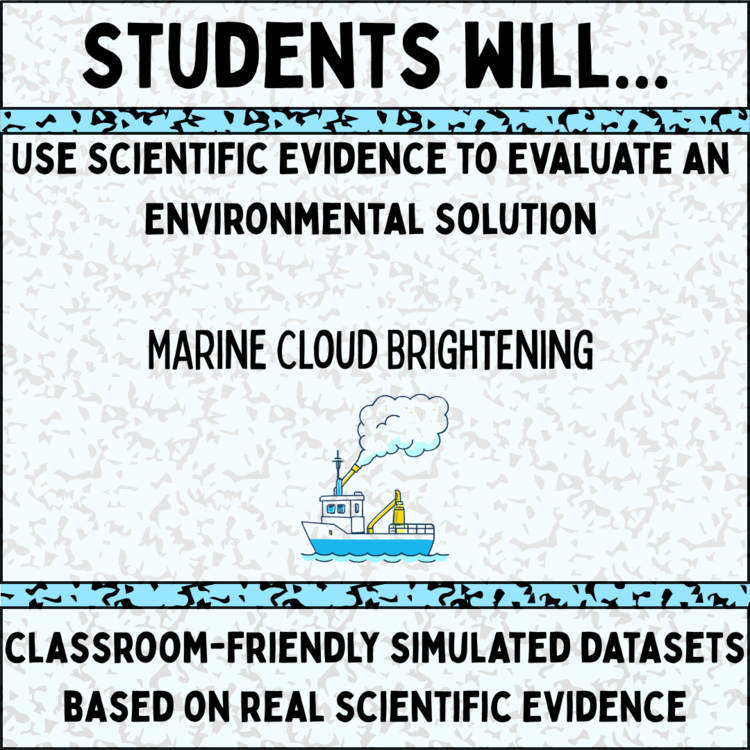
This is a S.E.E.D. Framework activity: students evaluate Marine Cloud Brightening as an Arctic sea ice solution using scientific evidence, weighing effectiveness, costs, and tradeoffs before writing an evidence-based recommendation. The exact component list (readings, data sets, page count, answer key) is not enumerated in the current listing and should be confirmed before this section is expanded.
How it runs in class
Students state the problem — sea ice loss and the feedback loops it triggers — then examine the evidence behind cloud brightening, evaluate feasibility including scale and unintended effects on weather and ecosystems, and determine a recommendation. Because the proposal sits at the edge of current practice, the activity builds something rarer than content: how scientists argue about interventions that are physically plausible, partially tested, and deeply contested. Student recommendations split, and the CER writing has to do real work to defend either side.
Built on the S.E.E.D. Framework
This activity runs the complete S.E.E.D. Framework: State the Problem, Examine the Evidence, Evaluate Feasibility, Determine a Recommendation. Contested proposals are where the framework proves itself — Evaluate Feasibility and the evidence standard keep the discussion scientific when opinions run hot.
Standards alignment
NGSS: HS-LS2-7, HS-ESS3-4. Grades 8–12 · Biology, Earth Sciences, Environment.
Leave room for the governance question, because students will raise it: if a technology can cool one region’s ocean, who decides to deploy it, and who bears the side effects downwind? The S.E.E.D. structure keeps that discussion grounded — it belongs in the feasibility and recommendation steps, argued from evidence — rather than letting it float free of the science.
Compare it with a direct ice-building proposal in the Sea Ice Thickening activity, or get all three Arctic strategies in the Arctic Sea Ice CER Bundle ($10.25 instead of $12.75 separately). Free resources are in the Free Library.
Related products
-
Sale!
CER Practice: Climate Change Arctic Sea Ice Bundle (Biology)
Original price was: $12.75.$10.25Current price is: $10.25. -
Sale!
CER Practice: Climate Change Ocean Acidification Bundle (Biology)
Original price was: $12.75.$10.25Current price is: $10.25. -
-
Sale!

CER Practice: Climate Change Coral Bleaching Bundle (Biology)
Original price was: $12.75.$10.25Current price is: $10.25.
Reviews
There are no reviews yet.