
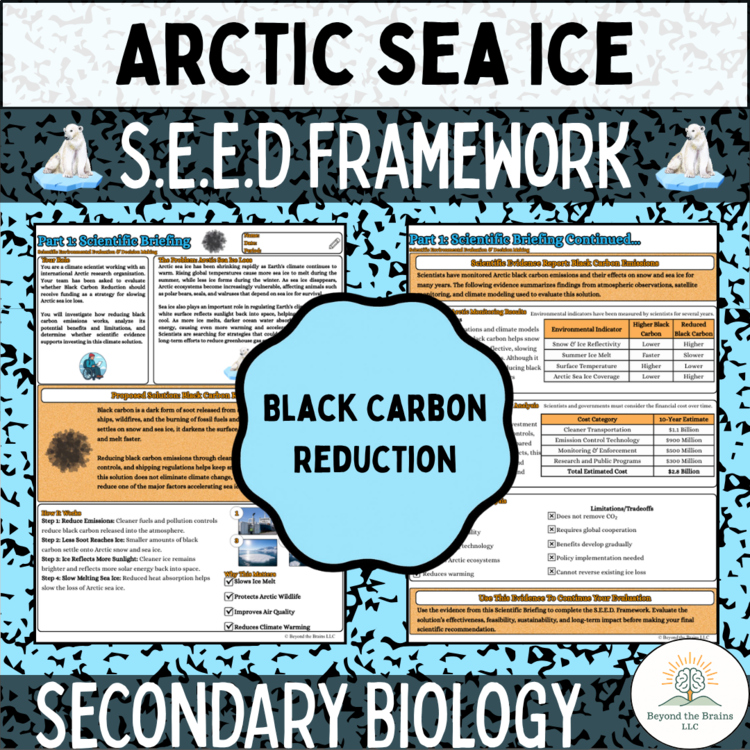

CER Practice: Climate Change Arctic Black Carbon Reduction
$4.25
S.E.E.D. Activity | 8th – 12th | Biology, Earth Sciences, Environment
Description
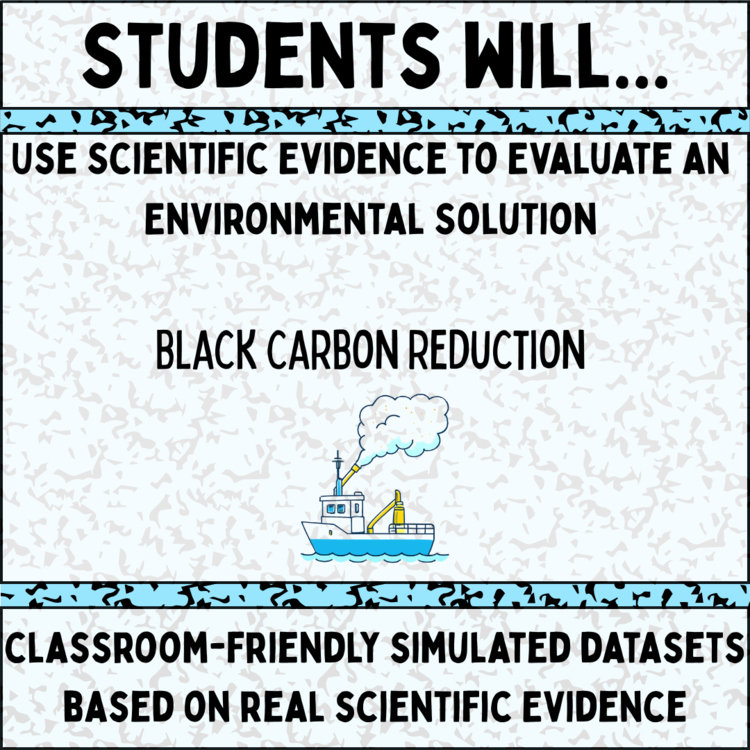
Some Arctic warming arrives as a smudge. Black carbon — soot from combustion — travels through the atmosphere, settles on snow and ice, and darkens the surface. Dark ice absorbs sunlight instead of reflecting it, so the Arctic melts faster. Cutting black carbon is therefore one of the more direct levers available: reduce the soot, slow the warming. Students evaluate whether the evidence supports black carbon reduction strategies as a serious Arctic intervention.
What’s inside
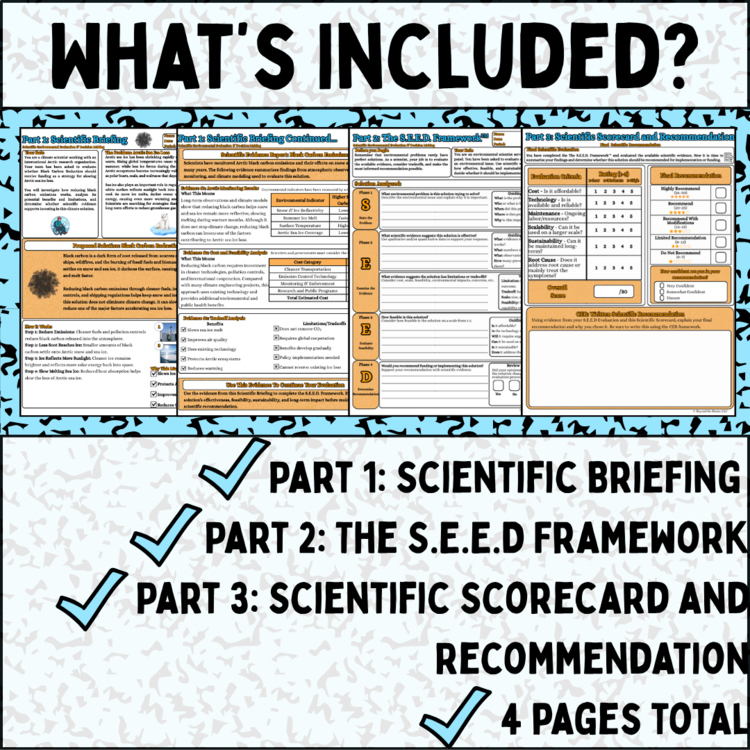
This is a S.E.E.D. Framework activity: students evaluate Black Carbon Reduction strategies to slow Arctic warming using scientific evidence, weighing effectiveness, costs, and tradeoffs before writing an evidence-based recommendation. The exact component list (readings, data sets, page count, answer key) is not enumerated in the current listing and should be confirmed before this section is expanded.
How it runs in class
Students begin with the mechanism — albedo, deposition, melt — stated as a problem, then examine the evidence behind reduction strategies, evaluate feasibility (where the soot comes from, what cutting it requires), and determine a recommendation in CER writing. The activity connects atmospheric science to ice in a way students can follow end to end, and it pairs well with direct instruction on feedback loops: less ice means more absorption means less ice.
Built on the S.E.E.D. Framework
This activity runs the complete S.E.E.D. Framework: State the Problem, Examine the Evidence, Evaluate Feasibility, Determine a Recommendation. It is a strong example of the framework’s middle steps — the evidence is a causal chain, and evaluating feasibility means tracing that chain back to sources students can actually picture.
Standards alignment
NGSS: HS-LS2-7, HS-ESS3-4. Grades 8–12 · Biology, Earth Sciences, Environment.
Black carbon also gives students a cleaner causal story than most climate topics: it is a pollutant with sources they can name and a mechanism they can draw. The albedo feedback it feeds — dark surface, more absorption, more melt, darker surface — is worth diagramming as a class, because once students can explain one feedback loop properly, the Arctic’s other loops stop being mysterious.
Compare a geoengineering approach in the Sea Ice Thickening activity, or get all three Arctic strategies in the Arctic Sea Ice CER Bundle ($10.25 instead of $12.75 separately). Free resources are in the Free Library.
Related products
-
-
-
-
Sale!
CER Practice: Climate Change Arctic Sea Ice Bundle (Biology)
Original price was: $12.75.$10.25Current price is: $10.25.
Reviews
There are no reviews yet.